

Sea Boil
Recipes for scene, dinner, and dessert

If you like the crisp edges of lasagne, the soaked croutons, the whipped cream that gets icy around the chocolate scoop - you’re in the right place.
If there was ever a time to commit to a Sea Boil and reward yourself with its briny pleasures, it is August. The days are long and hot (God willing), and your calendar may finally give you enough time to gather an intrepid shopping list that includes clams, mussels, lobsters, and seaweed, then spend an evening around a paper-covered table cracking shells and dipping sweet meat into drawn butter. It really is a late-summer fantasy: sweaty, messy, and communal.
We hosted one at Stissing House last weekend, and it was so magical—and replicable (well, some of it!)—that I thought I’d hand the newsletter over to the people who made it. First, Katie Pearce, who put the whole thing together, shares her inspiration and how she set the scene. Then David Nathans, who somehow landed a 15-foot cauldron in our yard and steamed 60 lobsters, plus everything else, shares a scaled-down recipe for 10 people. And finally, Rebecca Ellis, whose recipe for watermelon jelly set in the watermelon rind is so obscenely delicious and whimsical, I hope you all attempt it at home.
It’s not the dog days just yet. Plan to do this before you lose all motivation to move.
Katie’s Scene


“The idea of hosting a sea boil came to me after reading a book called Saltwater Foodways by Sandra Oliver. I stumbled across it at an unassuming moment last winter and have clung to every word since. Sandra, a legendary New England food historian who worked at the Mystic Seaport Museum for decades, writes from her home on Islesboro, Maine, chronicling the foodways of coastal New England. But Saltwater Foodways is much more than a history book. It’s a visual journey through 19th-century celebrations, community feasts, and town fundraisers centered around food, each one demanding the involvement of everyone present.
The Sea Boil we threw this past weekend was inspired by that book, but defined by the feelings of those in attendance. We set the scenes to set the mood. There were two: one was the boil itself, which was outside, and the other was the service table.
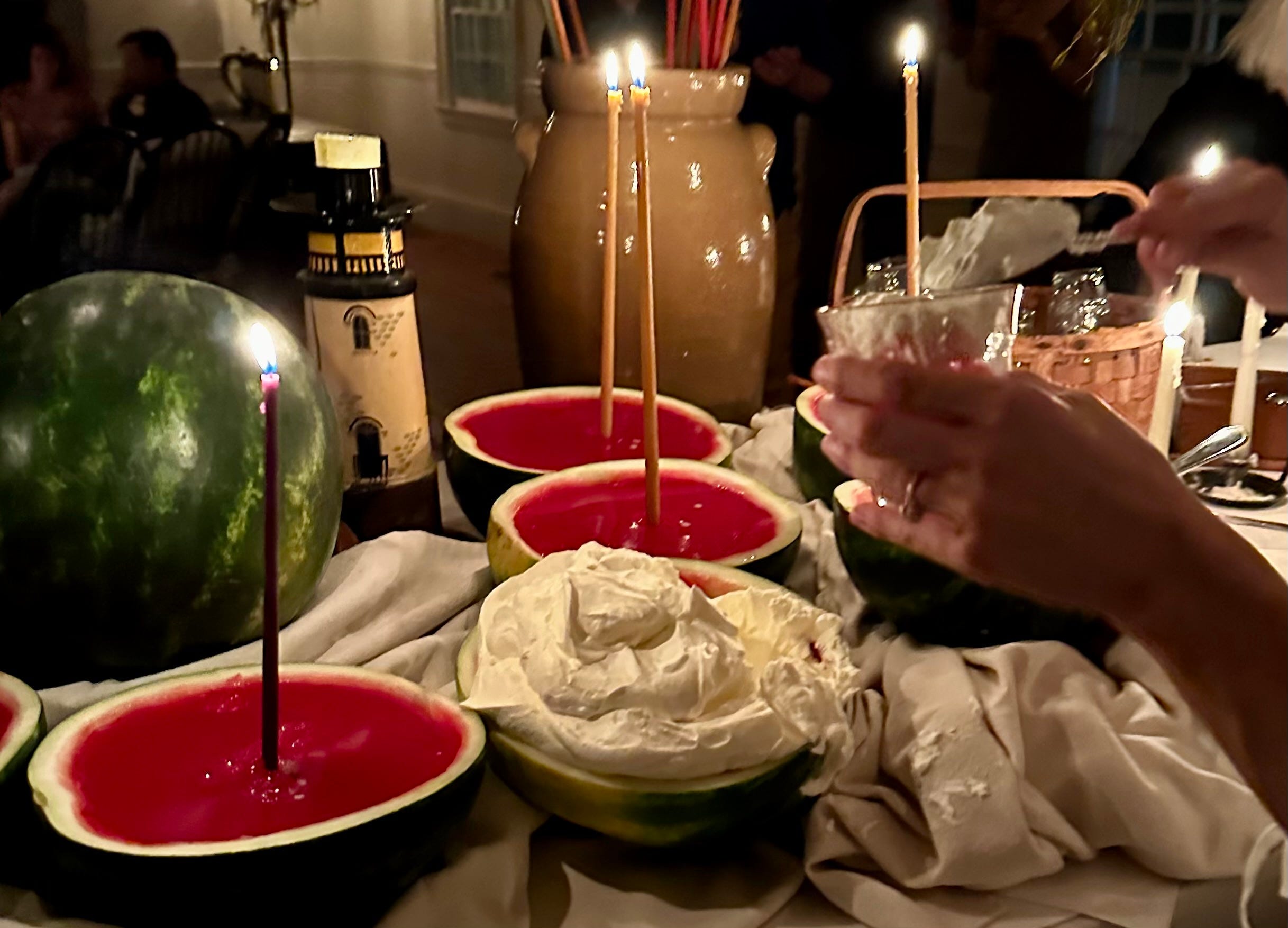
Both were pretty involved, to say the least, and came with a lot of keeping the faith that neither the town nor the rain would put out the fire heating the 15-foot-tall, 3-foot-wide iron cauldron. We all decided there would be no bad weather for this gathering—stormy skies or sunny blue skies, the ship would sail. And as someone who throws a lot of different parties every week, I stand by what I always say to clients: there is no bad weather at Stissing House. Rebecca ordered 15 watermelons to the kitchen door, emptied their insides, and filled them with the best watermelon jelly and whipped cream I’ve ever tasted in my life. So, if anything, we rested assured there would be dessert.
Once we had a date on the calendar, my décor search began. For this theme in particular, I first took a look around my house (and yard) for the sea junk that I cannot seem to stop collecting. I own a wooden lobster trap, hand-painted buoys, anchors, old ropes, oyster garlands, and far too many wooden boxes and baskets. I brought it all and ordered 40 pounds of seaweed from Maine to decorate every inch of the place (and my hair).
I was also fixated on other things to add ambiance—in this case, shanty singers. I was put in touch with Alex Garvey, who curates experiences through song and wrote songs for us to sing together telling the history of Stissing House. Between him and his partner, Aldo, they brought along six or seven instruments, which they switched between for almost three straight hours throughout the evening.
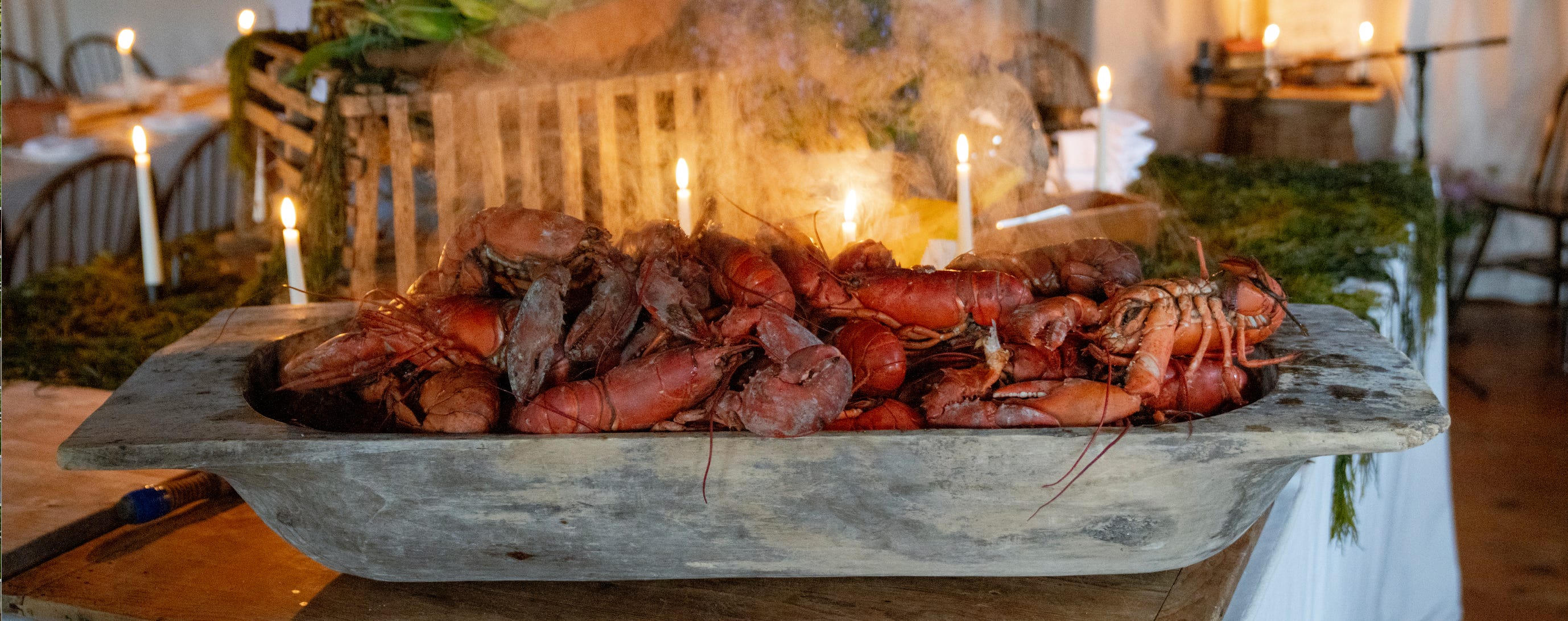
When everyone trickled in, they consumed about 200 oysters and gathered around the steaming cauldron. The party was in motion, and the focus became serving the boil. I rang the dinner bell when the seafood was cooked, and friends, new and old, took their seats around long tables, eagerly awaiting steaming lobsters piled in an enormous wooden dough trough, hot corn stacked in baskets, and salted potatoes with a glistening salt crust. Jocelyn ripped open each bag of clams and mussels and coated the bottom of cast-iron dishes with a mix of them and their jus. I draped handfuls of split lobsters David was cleaving over the top and placed them down the long tables. There was drawn parsley butter in abundance. And the whole room happily hummed along to sea shanties belted out by the Shinbone Alley Band.
As the eating waned, we decided to move the party into our transformed Ballroom: a scene of watermelon jelly (in the melons) dolloped with heaps of whipped cream. I looked at Clare, who attended with friends for our maiden voyage (on her birthday, no less!), and saw the bliss reflected on her face and on the faces of others with bellies full of clams and noses full of steam. I was the last to leave—much like the captain of a ship. The hanging seaweed was still shiny, smelling of the sea in the stormy, windswept room. I wondered whether there had ever been a Sea Boil in this room, or whether we were the first in 244 years. We may never know.”
David’s Boil


For 10 people
5 whole lobsters
~100 mussels (we love Bang Island, if you can’t find them use something meaty)
~100 little neck clams
10 ears of sweet corn, halved
3 pounds small Yukon Golds
A few branches of rosemary
3 garlic cloves, bashed
3 pounds seaweed (ordered from wherever you are getting your lobsters)
3 pounds salted butter
2 bunches parsley, chopped
Equipment: Cotton seafood boiling bags, a very large pot with a lid
Prepare your seafood: Place the mussels and clams each in a separate cotton bag, leaving enough space in each bag for the shells to pop open. You may need a few bags for each. Put your corn in bags.
Boil your potatoes: Cover the potatoes in cold water with enough salt added that the potatoes float. Throw in the rosemary and garlic. Simmer until soft, about 15-20 minutes. Drain and hold warm. The salt will start to dry on the skin and give a slight crunch.
Make your drawn butter: The “drawn” part of the butter just means melted—you can do this with a very low flame on a stove or just leave the butter somewhere warm for a while as you’re getting everything ready. Add your chopped parsley a few minutes before you’re ready to serve.
Boil! Rinse your seaweed to get rid of any sand and place in the bottom of your large pot. Pour in just enough water to cover the seaweed and bring to a soft simmer so the seaweed becomes soft and wherever you’re cooking smells like the ocean. This takes about 20 minutes.
Place your lobsters in the pot first and place the bags of clams on top of them. Cover with a lid and steam for about 5 minutes before adding the mussel and corn bags. When the mussels and clams start to open pull those bags out, along with the bags of corn. Pull out the lobsters when their shells turn red. Cooking time will vary depending on the size of your pot and seafood, but everything should take around 15-20 minutes. Taste your leftover steaming water in the bottom of the pot: if it’s delicious serve alongside everything for some extra dipping, or if it’s too salty, dilute it with extra water or discard. Place each lobster on a cutting board and using a heavy knife, slice it in half down the back to make two portions. Bash each of the claws with the base of your knife to crack them open slightly.
Cover your table with baking paper and tip the potatoes, corn, clams, and mussels onto it. Give each person a lobster half and get cracking! Big flaky salt and your drawn butter on the table and you’re good to go.
Rebecca’s Watermelon Jelly
Serves at least 8-10
1 watermelon
16 silver gelatin sheets (40g)
50-70g (¼-⅓ cup) granulated sugar
4g (1 tsp) fine sea salt
60g (¼ cup) lime juice
Cut the watermelon in half lengthwise and scoop out all of the red flesh leaving just a sliver of pink.
Pull off a long sheet of aluminum foil, twist or bunch it into a thick rope, and shape it into a ring or “nest.” Set your foil ring on a sheet tray or platter then place your hollowed out watermelon directly inside the foil ring. This will stabilize it and prevent it from moving. Place in the fridge.
Liquify the watermelon using either a cold press vegetable juicer or a blender. Strain the juice through a fine-mesh sieve, you should yield approximately 8 ¼ cups (1980g). Set aside.
Submerge the gelatin sheets in a bowl of ice water for 5 to 10 minutes until they soften.
Remove the sheets from the water, wrap the sheets in a paper towel, and squeeze out any excess liquid. Set aside.
Taste the watermelon juice and adjust the sweetness, adding between ¼ and ⅓ cup, depending on the ripeness of your melon.
Warm 2 ½ cups of watermelon juice, sugar, and salt over medium heat until the sugar is dissolved and the juice feels like a hot jacuzzi.
Whisk the softened gelatin sheets into the warm watermelon juice until completely dissolved.
Whisk in the remaining 5 ¾ cups watermelon juice and lime juice.
Strain the mixture through a fine-mesh sieve.
Pour the watermelon juice mixture into the hollowed out watermelon until it reaches the top (there may be extra that you can set in a bowl for a taste test).
Refrigerate at least 8 hours. Serve straight from the fridge alongside the other watermelon half filled with whipped cream.
Shanties are shacks. Chanties are songs.